
Aha! Alternatives in 2026: What Product Teams Actually Switch To
Aha! is powerful. It's also expensive, complex, and built for roadmaps. Not the messy pre-backlog decisions that feed them. Here's what teams are using instead.

· Updated
Aha! alternatives are product management tools teams adopt when Aha!'s per-seat pricing, suite complexity, or portal-only capture model stops fitting. IdeaLift is the alternative for teams whose feedback lives in Slack, Teams, and email rather than a customer-facing portal; ProductBoard fits teams that want a similar PM platform at a lower tier; Fider and Frill cover teams that just need a voting board.
Aha! is one of the most complete product management platforms on the market. It handles strategy, roadmapping, idea management, and customer portals all in one place. Teams that need that full suite, with the budget to match, are well-served.
But a lot of teams reach Aha! and find they're paying for a jet when they needed a car. The complexity is real. The cost is real. And the specific thing most teams actually struggle with, capturing and preserving decisions made in Slack, Teams, and email before they reach the roadmap, Aha! doesn't solve that either.
Here's an honest breakdown of what teams actually switch to, and why.
Looking for IdeaLift vs Aha! Ideas specifically? This post covers Aha! alternatives generally. For a direct side-by-side — pricing, feature matrix, migration playbook — see IdeaLift vs Aha! Ideas.
Why teams look for an Aha! alternative
Pricing is the first reason teams mention. Aha! starts around $59 per user per month. For a 10-person product organization, that's $7,000+ per year before you get to the advanced tiers. Enterprise plans go significantly higher.
The second reason is complexity. Aha! gives you enough rope to build an elaborate system. Teams often spend weeks configuring workflows, scoring models, and portal settings before doing any actual product work. That setup cost is real, especially for teams under 50 people.
The third reason is the most honest one: most teams use about 20% of what Aha! offers. They need a roadmap, a place to track ideas, and a way to see what's shipping. They don't need strategy frameworks, capacity planning, and a whiteboards module.
The alternatives
Productboard
Productboard is Aha!'s closest direct competitor. Both are built around the idea of centralizing product insights and connecting them to a roadmap. Productboard handles feature prioritization, customer feedback intake, and roadmap views. See our full ProductBoard alternatives comparison for more depth.
Where it falls short: Productboard requires your team to manually push feedback into it. Slack conversations, email threads, and meeting decisions don't flow in automatically. Someone has to log them. Most teams don't, because they're busy.
Best for: Mid-market teams that want Aha!-style depth at a lower price.
Canny
Canny focuses specifically on feature request collection and voting. It's simple, well-designed, and much cheaper than Aha!. Customers submit ideas, vote on them, and teams use the vote counts to prioritize. We cover more options in our Canny alternatives comparison.
The limitation is fundamental: vote counts tell you what customers want. They don't tell you why decisions were made, who made them, or what context surrounded them. And they only capture what customers choose to submit through the portal. Everything discussed internally in Slack or Teams is invisible to Canny.
Best for: Teams primarily managing public-facing feature request intake.
Linear
Linear is the fastest-growing tool in the space. Built for engineering-driven teams, it does issue tracking and project management exceptionally well. It's opinionated, clean, and fast.
But Linear starts at the backlog. It assumes decisions have already been made. There's no layer for capturing the conversations, debates, and signals that happen upstream before a ticket is created.
Best for: Engineering-led teams that want a fast, modern Jira replacement.
Notion
Many teams replace Aha! with Notion because it's flexible. You can build a product wiki, roadmap, decision log, and idea board all in one place. The cost is low and the setup is fast.
The problem: Notion is only as good as what people put in it. It has no ambient capture. Nothing flows in automatically from Slack or email. It's a beautiful filing cabinet for information people remember to save.
Best for: Small teams that need simple documentation more than structured product management.
IdeaLift
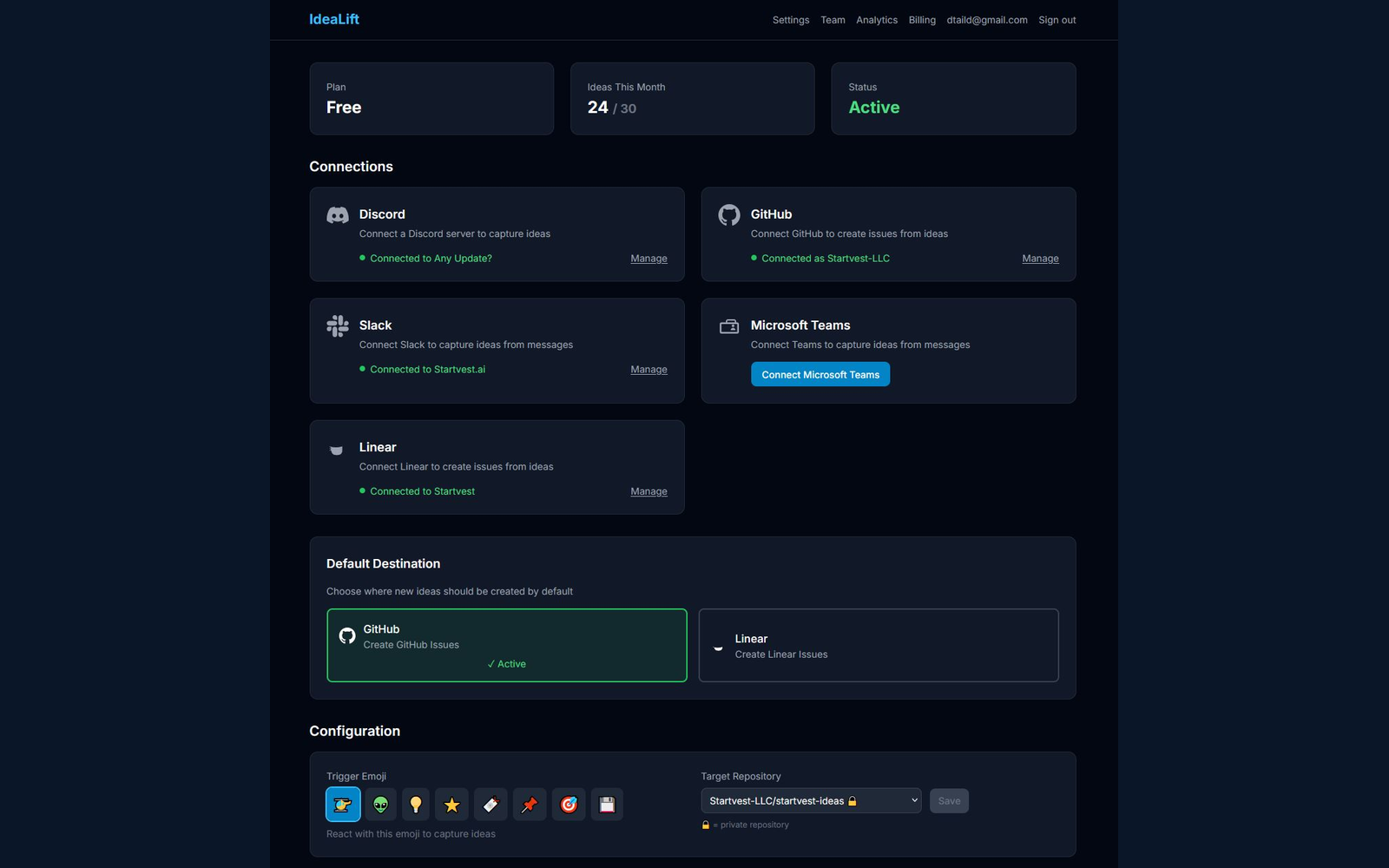
IdeaLift doesn't try to replace Aha!'s roadmapping features. It fills the gap that Aha! and every other tool leaves open: the space between where decisions are made and where they become tickets.
Product decisions don't start in Aha!. They start in a Slack thread at 4pm on a Wednesday. They surface in a Teams call where the VP says "let's go with option B." They show up in an email chain where a customer describes a broken workflow. By the time any of that reaches Aha!, half the context is already gone.
IdeaLift captures that context ambiently. No behavior change required. It monitors the channels your team already uses, identifies when decisions occur, and preserves who decided, why, and what was rejected. When the decision becomes a ticket, the full story travels with it.
Best for: Teams that already have a backlog tool and keep losing decisions between Slack and their roadmap.
Head-to-head: key differences
| Tool | Ambient Capture | Decision Memory | Pricing Start | Roadmapping |
|---|---|---|---|---|
| Aha! | No | No | $59/user/mo | Yes |
| Productboard | No | No | $20/user/mo | Yes |
| Canny | No | No | $79/mo | Limited |
| Linear | No | No | $8/user/mo | Basic |
| Notion | No | No | $8/user/mo | Manual |
| IdeaLift | Yes | Yes | Free (Starter) | Via Jira |
Every tool in this table manages work that's already in the backlog. IdeaLift manages what happens before it gets there. These aren't competing for the same job.
The real reason Aha! alternatives disappoint
Teams switching from Aha! usually want simpler and cheaper. They get that. What they don't get is a fix for the actual problem: decisions made in chat that never make it to any tool.
A team switching from Aha! to Productboard still loses decisions in Slack. A team switching from Aha! to Notion still has the same problem. The tool that stores the roadmap changed. The void upstream didn't.
That's the gap IdeaLift closes. Not the roadmap. The pre-backlog space where decisions form, get debated, and usually die unrecorded.
How to choose
If you need robust roadmapping and your team has the budget: Aha! is still the most complete option. If you want Aha!-style depth at lower cost: Productboard. If you primarily want to collect and prioritize customer feature requests publicly: Canny. If you want a fast, clean backlog and issue tracker: Linear. If you need a simple, flexible workspace: Notion.
If you keep losing decisions between Slack and your backlog, regardless of which tool you use, that's the IdeaLift problem.
Related reading: For the full breakdown with pricing tables and migration tips, see our comprehensive Aha! alternatives guide. Ready to switch? The step-by-step Aha! to IdeaLift migration playbook covers what transfers, what doesn't, and the sequence that doesn't break things. For a side-by-side feature comparison, see IdeaLift vs Aha! Ideas. Or compare feature request tracking software if capture is your primary gap.
FAQ
What is the best Aha alternative?
For teams that need roadmapping depth at lower cost, Productboard is the closest direct replacement. For teams whose real problem is losing decisions in Slack and Teams before they reach the roadmap, IdeaLift fills that gap. The best alternative depends on which part of Aha! you actually use.
Why switch from Aha?
Cost and complexity are the top two reasons. Aha! starts at $59/user/month, which adds up fast for growing teams. Many teams spend weeks configuring workflows and scoring models before doing any product work. If you use 20% of the features, you're overpaying for the other 80%.
Is Aha worth the price?
For large product organizations that use strategy frameworks, capacity planning, and the full roadmapping suite, yes. For teams under 50 people who mainly need a roadmap, idea tracking, and a changelog, the price is hard to justify. Simpler tools cover those needs at a fraction of the cost.
What is Aha.io used for?
Aha! is a full-stack product management platform. It handles product strategy, roadmapping, idea management, customer portals, and release planning. It's designed for enterprise product teams that want every product management function in one system.
IdeaLift captures product decisions ambiently from Slack, Teams, Discord, and email. No manual logging. Starter plan is free. Get started at idealift.app
Free Resource
Rescue Your Lost Feature Requests
A 5-step audit to find the ideas hiding in your team chat
Ready to stop losing ideas?
Capture feedback from Slack, Discord, and Teams. Send it to Jira, GitHub, or Linear with one click.
Continue Reading
View allMigrate from Aha to IdeaLift: Step-by-Step Migration Guide (2026)
Migrate from Aha to IdeaLift in 5 steps. Export ideas, map statuses, preserve customer vote counts, and pick the right lighter-weight tool for your roadmap.
Migrating from Aha! to IdeaLift: The Honest Playbook
Aha! is a powerful PM suite. Most teams use 20% of it and pay full price. Here's the step-by-step migration to IdeaLift — what transfers, what doesn't, and what to fix in your process before you switch.
7 Best Aha! Alternatives for Product Management Teams in 2026
Discover the top 7 Aha! alternatives for 2026 with AI-powered features, modern integrations, and superior remote collaboration capabilities that traditional alternatives miss.