
7 Best Canny Alternatives in 2026 (With Honest Comparison)
Looking for Canny alternatives? Full 2026 comparison of 7 feedback tools with pricing, pros/cons, and head-to-head breakdowns. Canny vs IdeaLift, ProductBoard, UserVoice, and more.

Canny is the go-to product feedback tool for many teams. Public voting boards, roadmaps, changelogs—it does a lot.
But it's not perfect for everyone. Maybe:
- The pricing doesn't fit ($79/mo minimum)
- You need better Slack/Discord integration
- A public board doesn't suit your customer base
- You want more AI-powered features
Whatever your reason, this guide covers 7 legitimate Canny alternatives with honest assessments of when to choose each.
Quick Comparison
| Tool | Starting Price | Best For | Slack/Discord Capture | Microsoft Copilot |
|---|---|---|---|---|
| Canny | $79/mo | Public-facing feedback boards | Limited | ❌ No |
| IdeaLift | Free (Starter) | Chat + Microsoft 365 teams | Native (emoji capture) | ✅ Native plugin |
| ProductBoard | $20/user/mo | Enterprise product teams | Zapier | ❌ No |
| Nolt | $29/mo | Simple public voting | No | ❌ No |
| Fider | Free (self-hosted) | Budget-conscious teams | No | ❌ No |
| Sleekplan | $13/mo | Startups wanting value | Limited | ❌ No |
| UserVoice | Custom | Enterprise, large scale | Limited | ❌ No |
| Notion | Free-$10/mo | DIY flexibility | Manual | ❌ No |
1. IdeaLift – Best for Chat + Microsoft 365 Teams
Price: Free (Starter), $79/mo (Pro), $199/mo (Growth)
What It Does
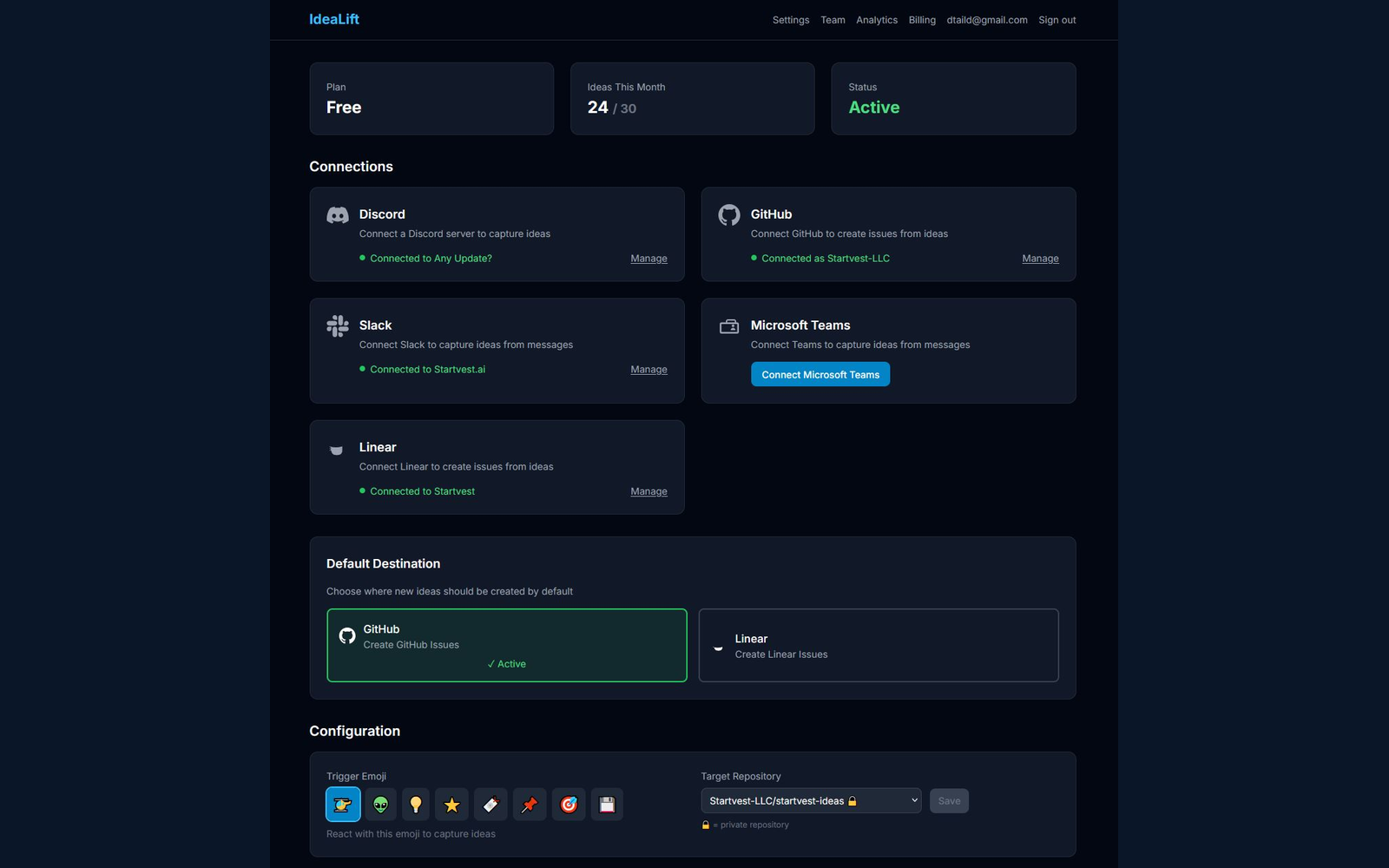
IdeaLift focuses on capturing feedback from where your team already communicates—Slack, Discord, Microsoft Teams, and the Microsoft 365 ecosystem. Instead of asking customers to visit a separate portal, you capture ideas with emoji reactions, Copilot commands, or directly from Outlook emails.
How It Works
From Chat:
- Customer posts feedback in Slack/Teams/Discord
- Anyone reacts with 👽 (or configured emoji)
- Feedback is captured with full thread context
- AI summarizes long conversations
- One-click sync to Jira, GitHub, or Linear
From Microsoft Copilot:
- Say "Capture this as an idea" in Copilot
- IdeaLift plugin processes the conversation
- Review the AI-structured ticket
- Confirm to create the issue
From Outlook:
- Open email with customer feedback
- Click IdeaLift in the ribbon
- Review extracted ideas
- Create tickets directly from your inbox
Strengths
- Native chat integration: No Zapier needed for Slack/Discord/Teams
- Microsoft Copilot plugin: Only feedback tool with native Copilot integration
- Outlook add-in: Capture ideas directly from email threads
- Zero-friction capture: Emoji reactions, Copilot commands, or one-click in Outlook
- Thread context: Captures full conversation, not just single message
- AI summarization: Long threads become clear descriptions
- Bi-directional sync: When Jira ticket closes, Slack gets notified
Weaknesses
- No public voting board (capture-focused, not voting-focused)
- Newer product, smaller community
- Less robust roadmap/changelog features than Canny
Best For
Teams where most feedback happens in Slack, Discord, or the Microsoft 365 ecosystem. Developer communities, internal product teams, B2B companies with dedicated customer channels, and enterprises using Microsoft Copilot.
Canny vs IdeaLift
| Factor | Canny | IdeaLift |
|---|---|---|
| Public voting | ✅ Core feature | ❌ Not focus |
| Slack capture | ⚠️ Basic | ✅ Native + AI |
| Microsoft Copilot | ❌ No integration | ✅ Native plugin |
| Outlook add-in | ❌ No | ✅ Native |
| Thread context | ❌ No | ✅ Full threads |
| Jira sync | ✅ One-way | ✅ Bi-directional |
| Price | $79/mo | Free (Starter) |
Choose IdeaLift if: Feedback lives in chat, Copilot, or email—not portals.
2. ProductBoard – Best for Enterprise Product Teams
Price: $20/user/month (scales with team size)
What It Does
ProductBoard is a full product management platform—feedback collection is just one piece. It includes roadmapping, prioritization frameworks, and customer segmentation.
Strengths
- Comprehensive: Feedback + roadmap + prioritization in one
- Customer segmentation: See feedback by segment, revenue, etc.
- Integrations: Intercom, Zendesk, Salesforce, Jira
- Prioritization scores: Built-in impact/effort frameworks
- Enterprise features: SSO, permissions, audit logs
Weaknesses
- Price scales fast: $20/user × 10 users = $200/mo
- Complexity: Overkill for smaller teams
- Learning curve: Takes time to set up properly
- No native Slack capture: Requires Zapier
Best For
Product teams at 50+ person companies with budget for proper tooling and need for customer segmentation.
Canny vs ProductBoard
| Factor | Canny | ProductBoard |
|---|---|---|
| Price (5 users) | $79/mo flat | $100/mo |
| Price (20 users) | $79/mo flat | $400/mo |
| Public voting | ✅ Core | ⚠️ Available |
| Roadmapping | ⚠️ Basic | ✅ Advanced |
| Segmentation | ⚠️ Limited | ✅ Detailed |
Choose ProductBoard if: You need the full product management suite, not just feedback.
3. Nolt – Best Simple Alternative
Price: Starting at $29/month
What It Does
Nolt is a lightweight feedback board—similar to Canny but simpler and cheaper. Public voting, status updates, no frills.
Strengths
- Simple: Easy to set up, easy to use
- Affordable: $29/mo vs Canny's $79/mo
- Clean UI: Minimalist, focused
- Custom domain: Your branding
- Anonymous voting: Optional
Weaknesses
- Very basic: Limited integrations
- No Slack capture: Manual entry only
- Limited analytics: Basic voting counts
- No AI features
Best For
Small teams wanting a public feedback board without Canny's price tag.
Canny vs Nolt
| Factor | Canny | Nolt |
|---|---|---|
| Price | $79/mo | $29/mo |
| Features | Many | Focused |
| Integrations | Good | Basic |
| Setup time | Moderate | Quick |
Choose Nolt if: You want a simpler, cheaper Canny.
4. Fider – Best Free Option (Self-Hosted)
Price: Free (open source, self-hosted)
What It Does
Fider is an open-source feedback board you can host yourself. It provides core voting board functionality without monthly fees.
Strengths
- Free: No subscription costs
- Open source: Fully customizable
- Self-hosted: Data on your servers
- Core features: Voting, comments, status updates
Weaknesses
- Self-hosted: Requires technical resources
- Limited integrations: Manual or DIY
- No support: Community only
- Basic features: No AI, limited automation
Best For
Technical teams with hosting infrastructure who want to avoid SaaS fees.
Canny vs Fider
| Factor | Canny | Fider |
|---|---|---|
| Price | $79/mo | Free |
| Hosting | Managed | Self-hosted |
| Setup | Easy | Requires DevOps |
| Support | Included | Community |
Choose Fider if: You're technical, budget-conscious, and want ownership of data.
5. Sleekplan – Best Value
Price: Starting at $13/month
What It Does
Sleekplan offers feedback boards, roadmaps, and changelogs at a fraction of Canny's price. Good feature set for the cost.
Strengths
- Affordable: $13/mo starting, $29/mo for pro
- Full-featured: Voting, roadmap, changelog included
- In-app widget: Embed feedback board in your app
- SSO: Even on lower tiers
- API access: For customization
Weaknesses
- Less polished: UI not as refined as Canny
- Smaller community: Less ecosystem
- Limited advanced features: No AI, basic analytics
- Slack integration: Basic, not native
Best For
Startups wanting Canny-like features at startup-friendly prices.
Canny vs Sleekplan
| Factor | Canny | Sleekplan |
|---|---|---|
| Price | $79/mo | $13-29/mo |
| Features | More | Enough |
| UI polish | High | Medium |
| Widget | ✅ | ✅ |
Choose Sleekplan if: Budget matters more than polish.
6. UserVoice – Best for Large Enterprise
Price: Custom pricing (typically $500+/mo)
What It Does
UserVoice is the OG feedback platform, built for large organizations with complex needs. It includes feedback portals, NPS, and product analytics.
Strengths
- Enterprise scale: Built for large user bases
- In-app feedback: SDKs for web and mobile
- Analytics: SmartVote, satisfaction tracking
- Support integration: Zendesk, Salesforce
- Compliance: SOC 2, GDPR, enterprise security
Weaknesses
- Expensive: Enterprise pricing
- Complex: Overkill for smaller teams
- Dated UI: Not as modern as newer tools
- Long sales cycle: No self-serve
Best For
Large companies (1000+ employees) with dedicated product ops teams.
Canny vs UserVoice
| Factor | Canny | UserVoice |
|---|---|---|
| Price | $79/mo | $500+/mo |
| Scale | SMB/Mid | Enterprise |
| Self-serve | ✅ | ❌ |
| Security | Good | Enterprise |
Choose UserVoice if: You're enterprise-scale with enterprise budget.
7. Notion – Best DIY Alternative
Price: Free for personal, $10/user/mo for teams
What It Does
Notion isn't a feedback tool—it's a flexible database and documentation platform. But many teams build DIY feedback systems in Notion.
How to Build Feedback in Notion
- Create a database with fields: Title, Description, Status, Votes, Submitted By
- Share public link for submissions
- Add views for different statuses (Kanban board)
- Manually update when features ship
Strengths
- Flexible: Build exactly what you need
- Cheap: $10/mo or free
- Already using it: No new tool to adopt
- Full control: Custom workflows
Weaknesses
- Manual: No automation without Zapier
- No native voting: Requires workarounds
- Limited integrations: DIY everything
- No notifications: Manual follow-up
Best For
Very early-stage teams who want to avoid another tool, or teams who live in Notion already.
Canny vs Notion DIY
| Factor | Canny | Notion DIY |
|---|---|---|
| Price | $79/mo | $10/mo |
| Setup time | 1 hour | 2-4 hours |
| Automation | Built-in | Zapier/manual |
| Maintenance | None | Ongoing |
Choose Notion if: You're scrappy and want to avoid SaaS sprawl.
Head-to-Head Comparisons
Canny vs IdeaLift
Canny and IdeaLift solve different problems. Canny gives your customers a place to submit and vote on ideas publicly. IdeaLift captures ideas from where your team already talks: Slack, Discord, Teams, Copilot, and Outlook.
If your feedback comes through a public portal, Canny wins. If your feedback lives in chat threads that nobody remembers to log, IdeaLift wins. IdeaLift starts at Free (Starter plan) vs Canny's $79/mo. The real question: do your customers visit a feedback portal, or do they message you directly?
Canny vs ProductBoard
ProductBoard is a full product management suite. Canny is a focused feedback and voting tool. ProductBoard costs $20/user/month, which means a 10-person team pays $200/mo vs Canny's flat $79/mo. ProductBoard earns that price if you need roadmapping, prioritization frameworks, and customer segmentation. If you just need a clean voting board with a public roadmap, Canny does the job for less money and less complexity.
Canny vs UserVoice
Both offer customer feedback portals, but they target different markets. Canny is self-serve, modern, and built for SMB/mid-market teams. UserVoice is enterprise-grade with SOC 2 compliance, mobile SDKs, and custom pricing starting around $500/mo. If you need compliance certifications and serve 1,000+ employees, UserVoice is built for you. Everyone else should stick with Canny or a lighter alternative.
Canny vs Nolt
Nolt is the budget Canny. Same core concept (public voting board) at roughly a third of the price ($29/mo vs $79/mo). Canny has better integrations, a more polished UI, and a changelog feature. Nolt has custom domains and anonymous voting. If you need the basics and nothing else, Nolt saves you $50/mo. If you want the ecosystem and polish, Canny is worth it.
Decision Framework
Choose Canny if:
- Public voting board is core to your strategy
- You want a polished, established tool
- You're in the $79/mo budget range
Choose IdeaLift if:
- Feedback lives in Slack/Discord/Teams
- You use Microsoft 365 and want Copilot integration
- You receive feature requests via email (Outlook add-in)
- You need AI summarization for threads
- You want bi-directional Jira sync
- Public voting isn't important
Choose ProductBoard if:
- You need full product management suite
- You have 10+ people on product team
- Customer segmentation is critical
Choose Nolt or Sleekplan if:
- Budget is the priority
- You need basic voting boards
- You don't need advanced features
Choose Fider if:
- You want free and self-hosted
- You have DevOps resources
- Data ownership matters
Choose UserVoice if:
- You're enterprise-scale
- You need compliance certifications
- Budget isn't a constraint
Choose Notion if:
- You're very early stage
- You want maximum flexibility
- You're okay with manual processes
Making the Switch from Canny
If you're migrating away from Canny:
Export Your Data
Canny allows CSV export of feedback, votes, and user data. Download before canceling.
Migration Paths
To IdeaLift:
- Set up Slack/Discord capture
- Import historical data (contact support)
- Notify users of new submission process
To ProductBoard:
- Import Canny CSV
- Map fields to ProductBoard schema
- Set up new integrations
To Sleekplan/Nolt:
- Manual recreation (smaller scale)
- Or CSV import if supported
Communicate to Users
If you have a public board, notify users: "We're moving our feedback system to [new tool]. Your existing votes have been migrated. Submit new ideas at [new URL]."
Conclusion
Canny is a solid product, but it's not the only option. The right choice depends on:
- Where your feedback lives: Chat/Copilot/Email → IdeaLift. Public portal → Canny/Nolt.
- Your tech stack: Microsoft 365 → IdeaLift (only tool with Copilot + Outlook). Slack-only → IdeaLift or Canny.
- Your budget: Tight → Sleekplan/Fider. Flexible → Canny/ProductBoard.
- Your scale: Startup → Nolt/Sleekplan. Enterprise → ProductBoard/UserVoice.
- Your needs: Simple voting → Nolt. Full PM suite → ProductBoard. Chat + AI capture → IdeaLift.
Don't pay for features you won't use. And don't skimp on tools that could transform your product process.
Related reading: Also considering other tools? See our ProductBoard alternatives and Aha roadmap alternatives comparisons, or browse the best product feedback tools.
Use Microsoft 365 or chat for feedback? Try IdeaLift free →
Free Resource
Rescue Your Lost Feature Requests
A 5-step audit to find the ideas hiding in your team chat
Ready to stop losing ideas?
Capture feedback from Slack, Discord, and Teams. Send it to Jira, GitHub, or Linear with one click.
Continue Reading
View allCanny Alternative: Feature Voting vs. Decision Memory
Canny tracks what customers ask for. It doesn't track what your team decides. That's a different problem and it needs a different tool.
Nolt vs Canny: Voting Portal Comparison (2026)
Nolt vs Canny is the indie-vs-incumbent decision in customer feedback portals. Nolt is cheaper and simpler. Canny is more polished with deeper integrations. Here is the honest breakdown.
The Hidden Cost of Scattered Product Feedback
Your product feedback isn't missing. It's buried in 6 tools nobody cross-references. One request looks like six. Here's what that costs and how to fix it.