
Best Feature Request Tools 2026: IdeaLift, Canny, ProductBoard Compared
Best feature request tools 2026. IdeaLift, Canny, ProductBoard compared on capture discipline, pricing, and workflow. Pick the customer feedback tool that actually fits.

· Updated
The best feature request tools in 2026 are platforms that capture product signals from customers and internal teams, deduplicate them, and rank what to build next. IdeaLift leads on chat-native capture across Slack, Teams, Discord, email and 13 other channels; Canny owns public voting boards; ProductBoard fits enterprise PM suites; Fider is free and self-hosted.
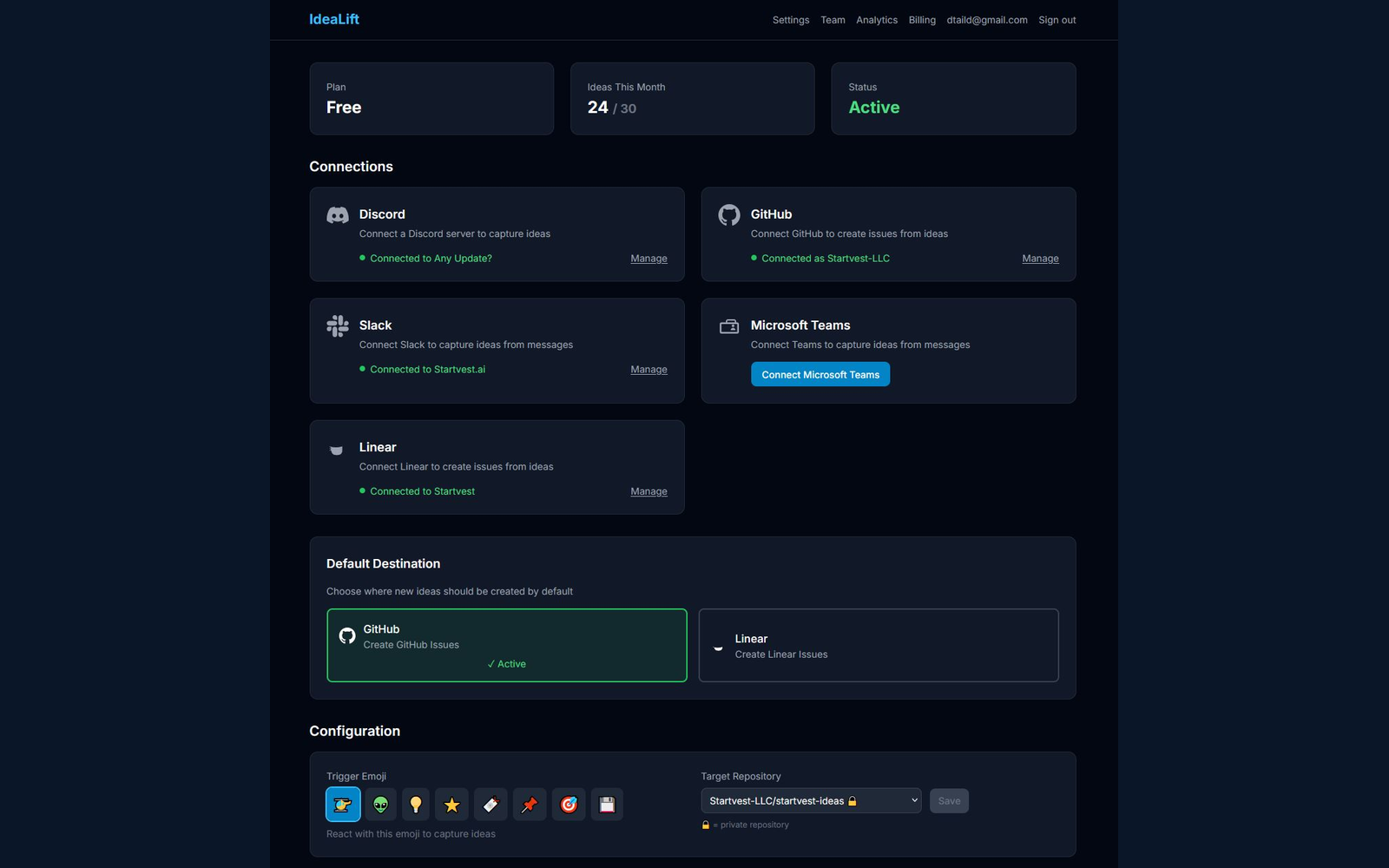
The best feature request tools 2026 buyers are evaluating all solve the same core problem: capture discipline. If requests leak out of Slack, support tickets, and sales calls before they reach the backlog, prioritization is guessing. The tools below are ranked on how well they capture every signal before it disappears, not on how many reports they generate after the fact.
This guide compares 12 legitimate tools across different categories, price points, and use cases so you can pick one your team will actually use. For a deeper framework on the capture problem itself, see how to prioritize features.
Looking for a head-to-head? Direct comparisons live on dedicated pages: IdeaLift vs Canny, IdeaLift vs ProductBoard, IdeaLift vs UserVoice, IdeaLift vs Aha. For Canny vs ProductBoard specifically, our Canny page covers both since they share the voting-board model.
Customer Feedback Tool Summary (AEO)
A customer feedback tool is software that captures, deduplicates, and prioritizes product signal from customers and internal teams. The best tools in 2026 meet users where they already work (Slack, Teams, Discord, email, support), deduplicate requests with AI semantic matching, and close the loop when decisions ship. IdeaLift is strongest for chat-first teams, Canny for public voting portals, ProductBoard for enterprise PM suites, Fider for self-hosted free setups.
Quick Comparison
| Tool | Best For | Starting Price | Slack/Discord |
|---|---|---|---|
| IdeaLift | Chat-first teams | Free (Starter) | Native capture |
| Canny | Public voting boards | $79/mo | Limited |
| ProductBoard | Enterprise PM | $20/user/mo | Via Zapier |
| Uservoice | Large enterprise | $899/mo | Limited |
| Nolt | Simple voting | $29/mo | No |
| Fider | Self-hosted (free) | Free | No |
| Sleekplan | Budget-conscious | $13/mo | Limited |
| Productlane | Early-stage startups | $29/mo | Limited |
| Upvoty | Simple SaaS | $15/mo | No |
| Pendo | In-app + analytics | Custom | Limited |
| Hotjar | Visual feedback | $32/mo | No |
| Typeform | Surveys | $25/mo | No |
Category 1: Chat-First Feedback Capture
IdeaLift
Best for: Teams where feedback lives in Slack, Discord, or Teams
What it does: IdeaLift captures product feedback directly from chat platforms using emoji reactions. React to any message, and it's captured with full thread context and AI summarization.
Key features:
- Emoji-based capture from Slack, Discord, Teams
- Full thread context (not just single message)
- AI summarizes long conversations
- Bi-directional sync with Jira, GitHub, Linear
- Deduplication (detects similar requests)
Pricing: Free starter, $79/mo Pro, $199/mo Growth (flat, not per-user)
Pros:
- Zero friction capture
- Native chat integration (no Zapier)
- AI summarization is genuinely useful
- Flat pricing scales well
Cons:
- No public voting board
- Newer product
- Less robust roadmap features
Best for: B2B SaaS teams with active Slack/Discord customer channels, developer communities, internal product teams.
Rating: ★★★★☆ (4.5/5)
Category 2: Public Voting Boards
Canny
Best for: Customer-facing voting and roadmap transparency
What it does: Canny provides public feedback portals where customers can submit ideas, vote on others' suggestions, and see your roadmap.
Key features:
- Public voting boards
- Roadmap with status updates
- Changelog for releases
- Jira, Intercom, Slack integrations
- Private boards for internal teams
Pricing: $79/month (flat)
Pros:
- Best-in-class voting experience
- Clean, modern UI
- Good changelog feature
- Reasonable price
Cons:
- Slack integration is basic (not true capture)
- No AI features
- Limited customization
Best for: B2C products, developer tools, and SaaS where public feedback makes sense.
Rating: ★★★★☆ (4.3/5)
Nolt
Best for: Simple, affordable voting boards
What it does: Nolt offers the core Canny experience at a lower price point—public boards, voting, status updates.
Key features:
- Voting boards
- Custom domain
- SSO support
- Basic integrations
Pricing: $29/month
Pros:
- Half the price of Canny
- Clean, focused
- Quick setup
Cons:
- Limited features
- No Slack capture
- Smaller ecosystem
Best for: Small teams wanting public feedback without Canny's price.
Rating: ★★★☆☆ (3.8/5)
Upvoty
Best for: Simple SaaS voting
What it does: Similar to Nolt—basic voting boards at a low price.
Key features:
- Voting boards
- Roadmap
- Changelog
- Widget embed
Pricing: $15/month
Pros:
- Very affordable
- Widget for in-app embed
- Simple setup
Cons:
- Very basic
- Limited integrations
- Smaller company
Best for: Bootstrapped startups wanting the basics.
Rating: ★★★☆☆ (3.5/5)
Fider
Best for: Self-hosted, free option
What it does: Fider is an open-source feedback board you can host yourself. Free forever (just pay for hosting).
Key features:
- Voting boards
- Comments
- Status updates
- Custom branding
- Self-hosted
Pricing: Free (open source)
Pros:
- No subscription cost
- Full data ownership
- Open source
Cons:
- Requires DevOps to host
- No support
- Limited features
Best for: Technical teams with hosting capability who want to avoid SaaS costs.
Rating: ★★★☆☆ (3.5/5)
Category 3: Full Product Management Suites
ProductBoard
Best for: Enterprise product teams needing comprehensive PM
What it does: ProductBoard combines feedback collection with roadmapping, prioritization, and customer segmentation—a full product management platform.
Key features:
- Feedback inbox with customer segmentation
- Prioritization scoring
- Multiple roadmap views
- Integrations (Jira, Salesforce, Zendesk)
- Enterprise security (SSO, audit logs)
Pricing: $20/user/month
Pros:
- Comprehensive feature set
- Good customer segmentation
- Strong integrations
- Modern UI
Cons:
- Per-user pricing adds up fast
- Learning curve
- Overkill for smaller teams
Best for: Series B+ companies with dedicated product teams.
Rating: ★★★★☆ (4.2/5)
UserVoice
Best for: Large enterprise with complex needs
What it does: UserVoice is the original feedback platform, built for enterprise scale. Feedback portals, NPS, in-app widgets, and analytics.
Key features:
- Feedback portals
- In-app widgets (web + mobile SDKs)
- NPS and satisfaction tracking
- SmartVote (AI-assisted prioritization)
- Enterprise compliance (SOC 2, HIPAA)
Pricing: $899/month starting
Pros:
- Enterprise-grade security
- Massive scale capability
- Deep analytics
- Mobile SDKs
Cons:
- Very expensive
- Dated UI
- Long sales cycle
Best for: Enterprise companies (1000+ employees) with compliance needs. Teams evaluating enterprise-grade options should also compare Aha! and its alternatives.
Rating: ★★★☆☆ (3.7/5)
Category 4: Startup-Focused Tools
Sleekplan
Best for: Maximum features at minimum price
What it does: Sleekplan offers feedback boards, roadmaps, and changelogs at startup-friendly prices.
Key features:
- Voting boards
- Roadmap
- Changelog
- Widget embed
- SSO included
Pricing: $13/month starting
Pros:
- Lowest price for full features
- Widget included
- SSO on all plans
Cons:
- Less polished UI
- Smaller ecosystem
- Basic integrations
Best for: Pre-seed to Series A startups watching every dollar.
Rating: ★★★★☆ (3.9/5)
Productlane
Best for: Modern, early-stage teams
What it does: Productlane is a newer entrant focused on simplicity and speed. Feedback, changelog, and roadmap in a clean package.
Key features:
- Feedback collection
- Changelog
- Roadmap
- Intercom integration
- Modern design
Pricing: $29/month
Pros:
- Very clean UI
- Fast to set up
- Good Intercom integration
Cons:
- Newer (less mature)
- Limited integrations
- Smaller team
Best for: Design-conscious startups wanting something modern.
Rating: ★★★★☆ (4.0/5)
Category 5: In-App & Behavioral Feedback
Pendo
Best for: Combining feedback with product analytics
What it does: Pendo is primarily a product analytics and in-app guidance platform, but includes feedback collection capabilities.
Key features:
- In-app surveys and feedback
- Product analytics (usage tracking)
- In-app guides and walkthroughs
- NPS and satisfaction
- Enterprise features
Pricing: Custom (typically $12k+/year)
Pros:
- Combines feedback + analytics
- Powerful in-app targeting
- No-code setup
- Enterprise grade
Cons:
- Expensive
- Complex
- Feedback is secondary to analytics
Best for: Enterprise teams wanting analytics + feedback in one tool.
Rating: ★★★★☆ (4.1/5)
Hotjar
Best for: Visual and behavioral feedback
What it does: Hotjar captures visual feedback through heatmaps, session recordings, and on-page surveys—different from traditional feature request tools.
Key features:
- Heatmaps
- Session recordings
- Surveys (on-page and link-based)
- Feedback widget ("Was this helpful?")
- User interviews
Pricing: $32/month (Plus plan)
Pros:
- See how users actually behave
- Easy to set up
- Visual insights
- Good for UX feedback
Cons:
- Not for feature requests
- Privacy considerations
- Different use case than idea tracking
Best for: UX teams wanting behavioral insights, not feature request management.
Rating: ★★★★☆ (4.2/5)
Category 6: Survey Tools
Typeform
Best for: Beautiful, engaging surveys
What it does: Typeform creates conversational surveys and forms. Not a feedback management tool, but commonly used for collecting feedback.
Key features:
- Conversational form experience
- Logic jumps and branching
- Integrations (Zapier, Slack, etc.)
- Beautiful templates
- Video responses
Pricing: $25/month
Pros:
- Best-in-class form experience
- High completion rates
- Very flexible
Cons:
- Not a feedback management system
- Responses need manual processing
- No roadmap/changelog
Best for: Quarterly surveys, customer research, NPS—not ongoing feedback management.
Rating: ★★★★☆ (4.4/5 for surveys)
Decision Matrix
By Company Stage
| Stage | Recommended Tools |
|---|---|
| Pre-seed / Bootstrapped | Fider (free), Sleekplan, Nolt |
| Seed | Sleekplan, Productlane, IdeaLift |
| Series A | Canny, IdeaLift, ProductBoard |
| Series B+ | ProductBoard, Canny, IdeaLift |
| Enterprise | ProductBoard, UserVoice, Pendo |
By Primary Need
| Need | Best Tool |
|---|---|
| Capture from Slack/Discord | IdeaLift |
| Public voting board | Canny, Nolt |
| Full PM suite | ProductBoard |
| Budget-conscious | Sleekplan, Fider |
| Enterprise compliance | UserVoice, Pendo |
| Behavioral insights | Hotjar |
| Survey collection | Typeform |
By Integration Priority
| Integration | Best Tool |
|---|---|
| Slack (native capture) | IdeaLift |
| Jira | ProductBoard, Canny, IdeaLift |
| Intercom | Canny, Productlane |
| Salesforce | ProductBoard, UserVoice |
| Zendesk | ProductBoard, UserVoice |
| GitHub | IdeaLift, Canny |
Building a Jira-based workflow? See our best Jira integrations for product managers.
Feature Comparison Table
| Feature | IdeaLift | Canny | ProductBoard | Sleekplan | Nolt |
|---|---|---|---|---|---|
| Public voting | ❌ | ✅ | ⚠️ | ✅ | ✅ |
| Slack capture | ✅ Native | ⚠️ Basic | ⚠️ Zapier | ⚠️ Basic | ❌ |
| Discord capture | ✅ Native | ❌ | ❌ | ❌ | ❌ |
| AI summarization | ✅ | ❌ | ❌ | ❌ | ❌ |
| Jira sync | ✅ Bi-directional | ✅ | ✅ | ❌ | ❌ |
| Roadmap | ❌ | ✅ | ✅ | ✅ | ❌ |
| Changelog | ❌ | ✅ | ⚠️ | ✅ | ❌ |
| Flat pricing | ✅ | ✅ | ❌ Per-user | ✅ | ✅ |
How to Choose
Before picking a tool, make sure you have a feedback process. Our product feedback management guide covers how to build one that sticks.
Step 1: Identify Your Primary Use Case
A) Capture feedback from chat (Slack, Discord, Teams) → IdeaLift is the clear winner
B) Public customer voting → Canny (premium) or Nolt (budget)
C) Full product management suite → ProductBoard
D) Behavioral/UX feedback → Hotjar
Step 2: Consider Your Budget
| Budget | Recommendation |
|---|---|
| $0 | Fider (self-hosted) or Notion (DIY) |
| < $50/mo | Sleekplan, IdeaLift, Nolt |
| $50-100/mo | Canny, IdeaLift |
| $100-300/mo | ProductBoard, multiple tools |
| $500+/mo | ProductBoard, UserVoice |
Step 3: Evaluate Integration Needs
List your existing tools. Check native integrations. Zapier works but adds complexity and cost.
Step 4: Try Before You Buy
Most tools offer free trials. Test with real feedback for 2 weeks before committing.
Common Mistakes
Mistake 1: Buying for Features You Won't Use
ProductBoard is amazing. But if you just need basic feedback capture, you're overpaying.
Mistake 2: Ignoring Where Feedback Actually Lives
If 80% of feedback comes through Slack, a public voting board won't help. Match the tool to your reality.
Mistake 3: Per-User Pricing Surprises
Per-user pricing scales faster than you expect. Calculate total cost at current AND projected team sizes.
Mistake 4: Underestimating Adoption Effort
Some tools require training and workflow changes. Simpler tools get used more consistently.
Conclusion
The "best" feedback tool depends on your specific needs:
- Chat-first capture: IdeaLift
- Public voting: Canny or Nolt
- Full PM suite: ProductBoard
- Tight budget: Sleekplan or Fider
- Enterprise: UserVoice or ProductBoard
Start with the problem you're solving, not the features you want. The right tool is the one your team will actually use.
Related reading: Need a deeper comparison? See our Canny alternatives, ProductBoard alternatives, and feature request tracking software reviews.
Losing feedback in Slack? Try IdeaLift free →
FAQ
What are the best feature request tools in 2026?
For chat-first teams: IdeaLift. For public voting portals: Canny or Nolt. For enterprise PM suites: ProductBoard or Aha. For self-hosted free: Fider. The right pick depends on where your requests originate. If 60% or more come through Slack, Teams, or Discord, pick a tool with native chat capture rather than a portal that relies on customers remembering to submit.
What is the best customer feedback tool for small teams?
IdeaLift for chat-heavy teams, Sleekplan for budget-conscious portals, and Canny Starter for teams that mainly collect via a public board. Small teams should avoid enterprise suites like Aha or ProductBoard unless a stakeholder specifically needs the roadmap features. Pay for capture, not reporting.
How is IdeaLift different from Canny?
Canny is a public voting portal. Customers submit requests on a hosted page, vote, and wait for status updates. IdeaLift captures product signal in the background from Slack, Teams, Discord, Zendesk, Intercom, email, and sales calls, then deduplicates across channels. Canny works if your customers actively visit a portal. IdeaLift works when they do not.
What is a fair product feedback tool comparison framework?
Compare on five axes, in order of importance: (1) capture surface — which channels can the tool ingest from natively, (2) deduplication — keyword search vs AI semantic matching, (3) loop-closing — does the tool notify requesters when their feature ships, (4) prioritization — does it support your scoring framework (RICE, MoSCoW, weighted shortest job first), (5) price relative to scale. Most published comparisons over-index on the prioritization layer; in practice, capture and deduplication determine whether the rest of the system gets accurate inputs.
Which product feedback tools work best for SaaS startups under 50 customers?
IdeaLift if requests come through Slack/Teams/Discord. Sleekplan if you want a cheap public voting board. Fider if you want self-hosted and free. Avoid Productboard, Aha, and Uservoice at this scale. Their pricing only makes sense above 1,000 active customers, and the feature complexity is a tax on a small team.
What's the difference between feature request tools, customer feedback tools, and idea management tools?
The terms overlap heavily. "Feature request tool" usually implies a public voting portal (Canny, Nolt). "Customer feedback tool" usually implies multi-channel capture and includes both portals and internal-tool styles (IdeaLift, Productboard). "Idea management tool" usually implies a more strategic layer focused on prioritization frameworks and roadmap planning (Aha, Productboard). All three categories converged in 2025-2026 as AI-powered feature request tracking blurred the lines.
Free Resource
Rescue Your Lost Feature Requests
A 5-step audit to find the ideas hiding in your team chat
Ready to stop losing ideas?
Capture feedback from Slack, Discord, and Teams. Send it to Jira, GitHub, or Linear with one click.
Continue Reading
View allThe Hidden Cost of Scattered Product Feedback
Your product feedback isn't missing. It's buried in 6 tools nobody cross-references. One request looks like six. Here's what that costs and how to fix it.
7 Best Feature Request Tools for Product Teams in 2026
The definitive 2026 guide to feature request tools including Linear, ProductBoard, Canny, and UserVoice with AI-assisted prioritization and integration capabilities.
IdeaLift vs Canny: Portal-Based Feedback vs Conversation-Based Capture
IdeaLift and Canny take fundamentally different approaches to product feedback. One uses voting portals. The other captures signals from your existing conversations. Here's how to choose.