
Organize Product Feedback in Slack: Never Lose Another Idea (2026)
Drowning in Slack messages? A simple system to organize product feedback, feature requests, and customer signals so nothing falls through the cracks.

Product feedback in Slack gets lost because Slack is built for conversation, not organization. The fix is a system: purpose-driven channels, emoji reactions that trigger automatic capture into your backlog, and weekly reviews to catch what slipped through. Tools like IdeaLift automate the capture so feedback goes straight from Slack to Jira, Linear, or GitHub without manual re-entry.
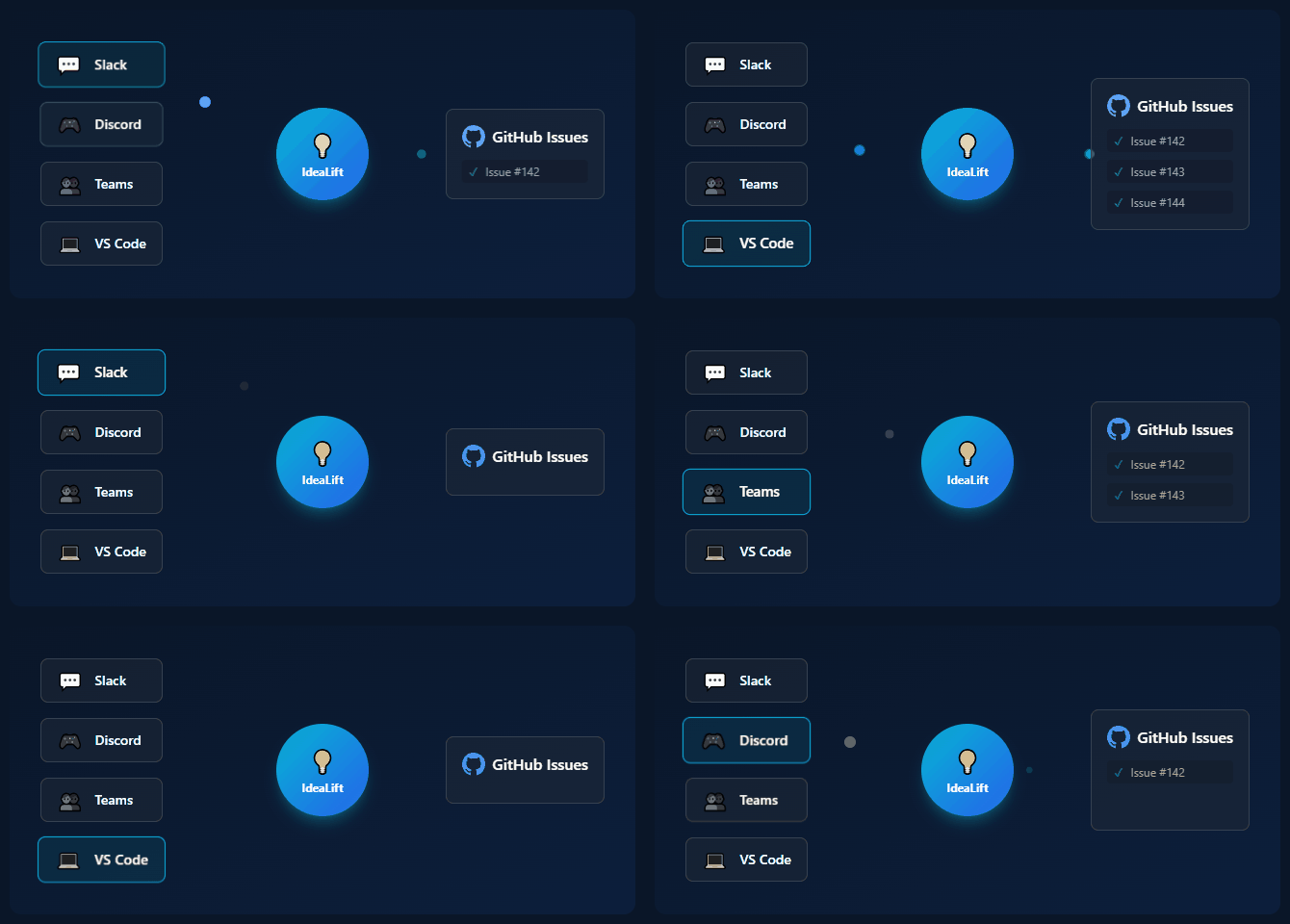
You have 847 unread Slack messages.
Somewhere in there is feedback from your biggest customer. A bug report that's about to become a support crisis. A feature idea that could change your product.
But you'll never find them. Because Slack is designed for conversation, not organization.
This is the Slack paradox: it's where your team communicates best, but it's where information goes to die.
Let's fix that.
The Slack Feedback Problem
Slack is phenomenal for real-time communication. It's terrible for:
Persistent Information
Messages scroll away. Unlike email, there's no natural "inbox" that holds things until you deal with them. Miss a day, miss everything.
Searchable Knowledge
Sure, Slack has search. But try finding "that thing someone said about the API last month." You'll scroll through 50 irrelevant results.
Actionable Tracking
Slack doesn't know the difference between:
- Casual conversation
- Important feedback
- Urgent bug report
- Feature request that needs tracking
Everything looks the same. Everything scrolls away the same.
Cross-Channel Context
The bug report started in #support, continued in #engineering, and was resolved in a DM. Good luck piecing that together.
The Cost of Slack Chaos
Let's quantify the problem:
| Problem | Business Impact |
|---|---|
| Missed customer feedback | Lost retention, bad product decisions |
| Duplicate discussions | Wasted time, no institutional memory |
| Untracked requests | Customers feel ignored |
| Information silos | Poor cross-team coordination |
| Context switching | 23 minutes to refocus after interruption |
Research shows: Workers spend 2.5 hours per day reading and responding to Slack messages. How much of that is productive?
The Slack Feedback Organization System
Here's a battle-tested system for keeping Slack useful without drowning:
Level 1: Channel Architecture
The wrong way: One channel for everything (#general-discussions, #team-chat, #random)
The right way: Purpose-driven channels with clear rules
Essential channel types:
| Channel | Purpose | Who Posts |
|---|---|---|
| #customer-feedback | Raw customer quotes/feedback | Support, Sales |
| #feature-requests | Ideas worth tracking | Anyone |
| #bugs-reports | Reproducible bugs | Support, QA |
| #decisions | Important decisions (searchable record) | Leads |
| #wins | Shipped features, closed deals | Anyone |
| #alerts-[system] | Automated alerts (narrow scope) | Bots only |
Channel rules to enforce:
- #customer-feedback: Only direct quotes, no commentary
- #feature-requests: Use template (who, what, why)
- #bugs-reports: Must include reproduction steps
Level 2: Capture Mechanisms
Channels organize discussion. But important messages still need to be captured somewhere permanent.
Option 1: Pin Important Messages Basic, but limited. Pins max out. Nobody checks them.
Option 2: Save to Thread + Tag Create a system: "When you see something important, reply with @feedbackbot" (or a designated person).
Option 3: Emoji Reactions as Triggers The best approach. Define emoji meanings:
| Emoji | Meaning | What Happens |
|---|---|---|
| 💡 | Feature idea worth tracking | Captured to idea inbox |
| 🐛 | Bug report | Creates Jira ticket |
| 📌 | Important, reference later | Saved to wiki/Notion |
| ⭐ | Customer quote, use in marketing | Saved to testimonials |
| 🔥 | Urgent, needs immediate attention | Pings on-call |
Implementation:
- Native: Slack workflows (limited)
- Zapier: Medium automation
- Dedicated tool: IdeaLift, Troops, etc. (full automation)
Level 3: The Weekly Digest
Not everything can be captured in real-time. Create a weekly ritual:
Friday Slack Review (15 minutes):
- Scan #customer-feedback for uncaptured insights
- Review #feature-requests, ensure all are tracked
- Check #decisions, summarize to stakeholders who missed it
- Move any important uncaptured messages to permanent home
Automate if possible:
- Weekly summary of #customer-feedback → Email to product team
- Top 5 discussed threads → Posted to #weekly-digest
Level 4: The Escape Hatch
Some information shouldn't live in Slack at all. Create escape routes:
| Information Type | Better Home |
|---|---|
| Feature requests | Product backlog (Jira, Linear, IdeaLift) |
| Bug reports | Issue tracker |
| Decisions | Decision log (Notion, Confluence) |
| Customer quotes | CRM or testimonials database |
| Process documentation | Wiki |
| Meeting notes | Shared docs |
The rule: Slack is for discussion. When discussion concludes, the outcome moves somewhere permanent.
Setting Up Emoji-Based Capture (Tutorial)
The highest-ROI change you can make. Here's how:
Step 1: Define Your Emoji System
Choose 3-5 emojis. Keep it simple.
| Emoji | Action | Destination |
|---|---|---|
| 💡 | Capture idea | IdeaLift / Product backlog |
| 🐛 | Report bug | Jira Bug project |
| 📝 | Save for reference | Notion database |
Step 2: Announce to Team
Post in #general:
📣 New system for capturing important messages!

When you see something worth tracking, react with:
💡 = Feature idea → goes to product backlog
🐛 = Bug report → creates Jira ticket
📝 = Worth saving → goes to team wiki

You can react to ANY message in ANY channel.
The person who reacts doesn't have to be the PM.
Let's never lose important feedback again!
Step 3: Set Up Automation
Option A: Zapier (Budget)
- Zap trigger: New reaction added
- Filter: Reaction = your emoji
- Action: Create record in Airtable/Notion/Jira
Limitation: Only works in public channels, misses thread context.
Option B: IdeaLift (Full-Featured)
- Install Slack app
- Configure capture emoji
- Connect to Jira/GitHub/Linear
- Done—thread context and AI summary included
Option C: Custom Bot (DIY)
Use Slack's Events API to listen for reaction_added. Build your own capture logic.
Step 4: First Week Nudges
Adoption requires reinforcement:
- Day 1: Announce the system
- Day 3: In relevant channel, say "Great idea from @sarah! I'm going to 💡 this so we don't lose it"
- Day 5: Share weekly summary: "This week we captured 12 ideas. Here's the best one..."
Step 5: Ongoing Maintenance
- Monthly: Review which channels have most captures (signal of value)
- Quarterly: Revisit emoji system (too many? not enough?)
- Always: Close the loop when captured ideas ship
Advanced Organization Tactics
Tactic 1: The Decision Channel
Create #decisions for important choices:
Rule: When a significant decision is made (anywhere), post summary to #decisions:
**Decision:** Migrating from MySQL to PostgreSQL
**Made by:** Engineering leads
**Date:** 2026-01-15
**Context:** [link to discussion thread]
**Rationale:** [2-3 sentences]
**Impact:** Database migration in Q2
Now you have a searchable decision log.
Tactic 2: Customer Voice Channel
Create #customer-voice for direct quotes only:
Rule: Only post exact customer quotes. No commentary. Tag with customer type.
"The export feature is too slow. We have to wait 30 minutes for reports."
— [Enterprise customer, $50k ARR]
Why: Product and engineering see real customer language. Powerful for prioritization.
Tactic 3: Threading Discipline
Enforce threading for discussions:
Don't:
Person A: We should add dark mode
Person B: Good idea
Person C: I disagree
Person D: (different topic entirely)
Do:
Person A: We should add dark mode
  → Thread: Person B: Good idea
  → Thread: Person C: I disagree, here's why...
Benefit: Main channel stays scannable. Discussions have context.
Tactic 4: The "Too Hot" Escalation
For urgent issues that need immediate attention:
- Define escalation emoji (e.g., 🔥)
- Set up: 🔥 reaction → DMs on-call person
- Reserve 🔥 for genuine urgency
Measuring Slack Health
Track monthly:
| Metric | Target | Why It Matters |
|---|---|---|
| Messages in #customer-feedback | Growing | More feedback captured |
| Ideas captured via emoji | 10+/week | System is being used |
| Time in Slack | Stable or decreasing | Efficiency improving |
| Unread message anxiety | Decreasing | System provides confidence |
Tools That Help
| Tool | What It Does | Price |
|---|---|---|
| IdeaLift | Emoji capture → Jira/GitHub with AI | Free (Starter) |
| Slack Workflows | Native automation (limited) | Free with Slack |
| Zapier | General automation | $20-50/mo |
| Notion | Knowledge base for Slack escapes | Free-$10/mo |
| Loom | Replace long messages with video | Free |
| Geekbot | Async standups, reduce meetings | $5/user/mo |
Common Mistakes
Mistake 1: Too Many Channels
More channels = more places to check = more overwhelm.
Fix: Consolidate. You need fewer channels than you think.
Mistake 2: No Channel Descriptions
Nobody knows what #team-alpha-synergy is for.
Fix: Every channel gets a description and clear posting guidelines.
Mistake 3: Relying on "I'll Remember"
You won't. Neither will your team.
Fix: If it's worth thinking about, it's worth capturing.
Mistake 4: DM Overuse
Important information trapped in DMs is invisible to the team.
Fix: Default to channels. DMs for truly private/sensitive content only.
Conclusion
Slack isn't going away. But Slack chaos doesn't have to be your reality.
The system:
- Architecture: Purpose-driven channels with clear rules
- Capture: Emoji reactions that trigger real tracking
- Digest: Weekly review to catch what slipped through
- Escape: Move important content to permanent homes
Start with one change: set up emoji capture for feature ideas. Once your team sees important feedback being tracked and shipped, the culture shifts.
FAQ
How do you collect product feedback from Slack?
Set up emoji reactions as capture triggers. When someone sees a feature request or customer quote, they react with a designated emoji (like a lightbulb), and a tool like IdeaLift automatically captures the message into your product backlog. This works in any channel without requiring people to change how they communicate.
How do you organize Slack feedback?
Create purpose-driven channels (#customer-feedback, #feature-requests, #bug-reports) with clear posting rules. Pair that with emoji-based capture to move important messages into permanent systems like Jira or Linear. Run a 15-minute weekly review to catch anything that slipped through the cracks.
What is the best tool for capturing Slack feedback?
IdeaLift captures Slack feedback via emoji reactions with full thread context and AI-generated summaries, then syncs directly to Jira, GitHub, or Linear. Zapier offers a budget alternative but misses thread context. Slack's native workflows work for basic routing but lack the AI categorization and deduplication that dedicated tools provide.
How do you prevent feedback from getting lost in Slack?
Combine three layers: channel architecture (purpose-driven channels with rules), capture mechanisms (emoji reactions that trigger automatic tracking), and a weekly digest review. The biggest mistake is relying on memory or manual logging. Automate the capture so feedback gets tracked whether or not someone remembers to do it.
Ready to turn Slack chaos into organized feedback? Try IdeaLift free →
Related reading: Once your Slack feedback is organized, the next step is routing it. Learn how to automatically send Slack messages to Jira or track feature requests without losing your mind.
Free Resource
Rescue Your Lost Feature Requests
A 5-step audit to find the ideas hiding in your team chat
Ready to stop losing ideas?
Capture feedback from Slack, Discord, and Teams. Send it to Jira, GitHub, or Linear with one click.
Continue Reading
View allThe Hidden Cost of Scattered Product Feedback
Your product feedback isn't missing. It's buried in 6 tools nobody cross-references. One request looks like six. Here's what that costs and how to fix it.
How to Migrate from Aha! Without Losing Critical Data
Complete guide to migrating from Aha! without losing critical product data, workflows, or team productivity. Systematic approach ensures zero downtime and preserves business continuity.
Produktfeedback-Management steigert Kundenzufriedenheit um durchschnittlich 23% bei systematischer Umsetzung
Systematisches Produktfeedback-Management steigert Kundenzufriedenheit um 23%. Automatisierte Prozesse für Sammlung, Analyse und Integration in 4 kritischen Phasen.